|
 History menu > History menu >
Great Malvern Cemetery
Tour 2
This page lists mostly military memorials recorded during the guided
tour of Great Malvern cemetery organised by Malvern Civic Society in July
2014, and after.
The index on this page is divided into three parts. The
first is a list of both civilian and military memorials. Then comes a
section about memorials to other soldiers of the Great War. Lastly is
mention of two WWII memorials which we have not located but others have
recorded on the Find a Grave website.
Read on, else click to
return to Menu of tours
Index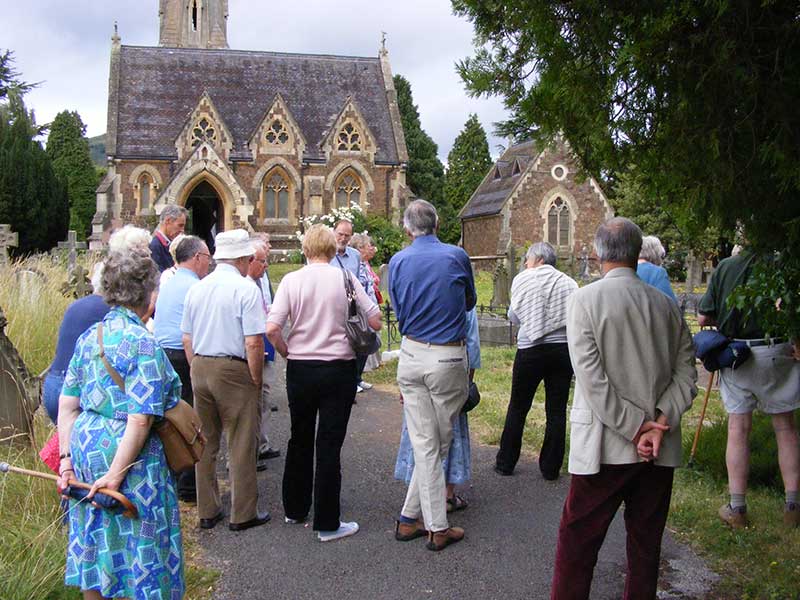
Neville Bellamy
Victor William Price
Harry Arbuthnot Acworth
Charles Robert Sutton
Charles Paul Ernest Giraudeau
Anthony Francis Bower Brodribb
Sidney Charles Smith
The MacDonald family
The Downes family
Alan Charles Lorraine Bate
Thomas Bowley
William Carveth
Robert Edwards
Francis Joseph Harison
Henry Ernest Hetherington
Edward Llewellyn
K Williams
Edwin John Sparks
Cumming Beynon Evans
 Not
far from the Wilton Road entrance to the cemetery are touching memorials to
two boys, Laurence Henry Holland who died in 1916 aged 14 years, and Neville
Bellamy. Not
far from the Wilton Road entrance to the cemetery are touching memorials to
two boys, Laurence Henry Holland who died in 1916 aged 14 years, and Neville
Bellamy.
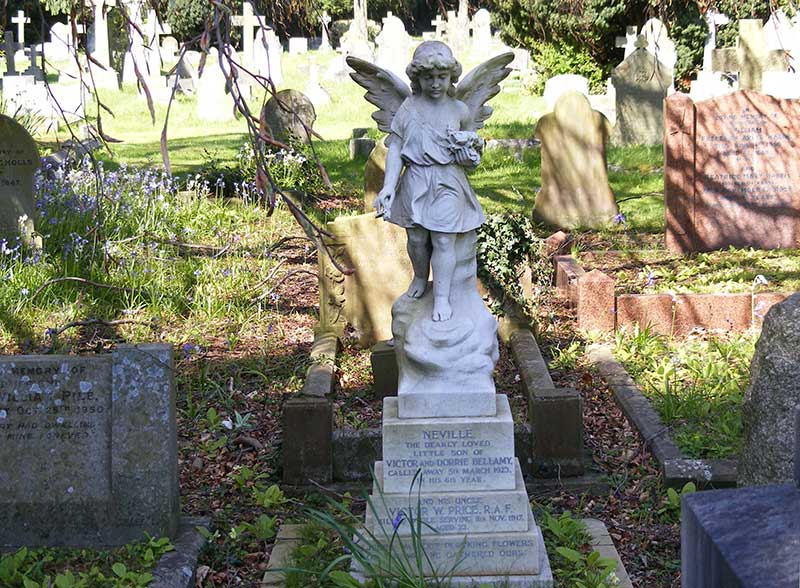
The memorial to Neville Bellamy shown opposite reads:
Neville, the dearly loved little son of Victor and Dorrie Bellamy called
away 5th March 1923 in his 6th year.
Neville was the only son of Albert Victor Bellamy and Malvern girl
Dorothy Beatrice Price. Neville was survived by a sister, Marian.
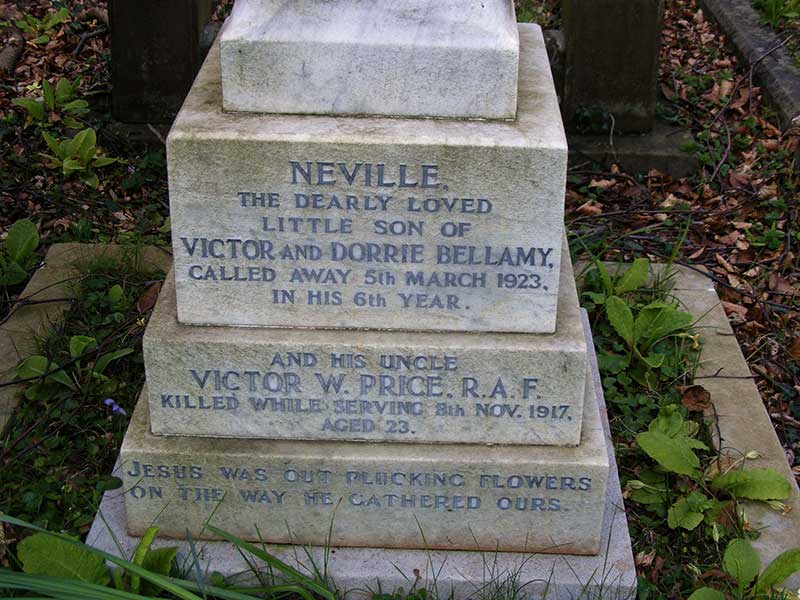 Below
the inscription to Neville Bellamy is a second inscription in memory of his
uncle who was killed in a flying accident. The second inscription
reads: Below
the inscription to Neville Bellamy is a second inscription in memory of his
uncle who was killed in a flying accident. The second inscription
reads:
and his uncle
Victor W Price RAF, killed while serving 8th Nov 1917
Jesus was out plucking flowers, on the way he gathered ours
Lieutenant Victor William Price, 14th Bn Worcester
Regiment, attached to 73 Squadron Royal Flying Corps, a passenger under
instruction, was killed when his Avro 504 biplane, serial number B3179, went into a
spinning nose-dive from 200 ft and crashed at
Lilbourne near Rugby on 8th November 1917 (refs 8 and 9). An RAF
casualty card records that he had already made 12 solo flights and had spent 19
hours in the air, 6 solo.
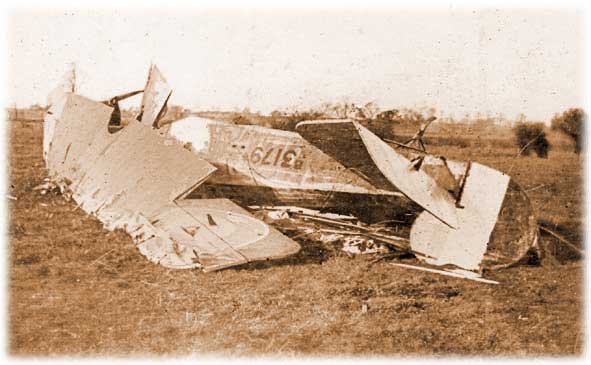
Wreckage - source: G Smith
The Commonwealth War Graves Commision records that Victor
was buried at Great Malvern cemetery in plot 8a, grave 148, and that this
was a private grave which first had a Military Wooden memorial.
The other occupant of the aircraft, instructor, 2nd Lt
Norman Eustace Sassoon Croager, Royal Flying Corps, died the same day
from his injuries. An account of his life can be found in reference 10. He
had been studying at Kelham Theological College when war was declared.
Victor was aged 23 years when he died. He was educated at
the
Lyttelton Grammar School,
Great Malvern, the only son of builder William Thomas and Beatrice Price of
West Malvern.
More information about Lt Victor William Price can be found on the
Malvern
Remembers website.
A cross upon a small pedestal marks the grave of a man
who retired to Great Malvern after a distinguished career in the Indian
Civil Service.
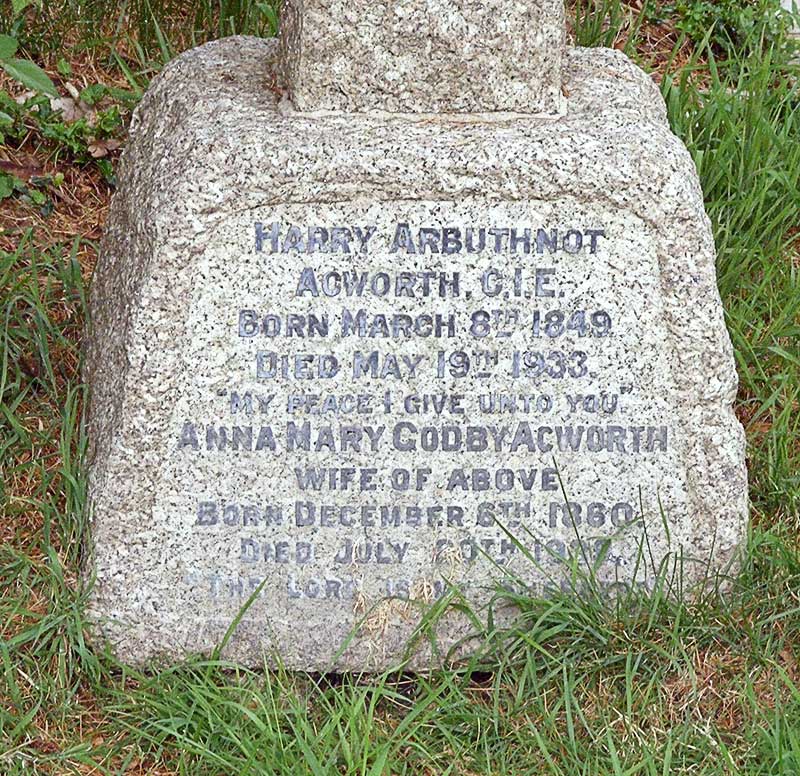
The inscription reads:
Harry Arbuthnot Acworth CIE
Born March 8th 1849
Died May 19th 1933
'My peace I give unto you'
Anna Mary Godby Acworth
wife of above
Born December 6th 1860
Died July 20th 1938
'The Lord is my shepherd'
The 1911 census records that Harry was born in Nice, Italy,
and that he was a retired Indian Civil Service pensioner. His wife was born
in Lahore, India. The Times reported that after two years of study he had
passed his final examination for the Civil Service of India in 1870.
The London Gazette records he was made a Companion of the
Order of the Indian Empire in 1895.
A 1902 Directory lists him as a Fellow of the University
of Bombay, JP, Great Malvern. Later Directories record him living at the
Walmer Lodge in Abbey Road, The Mythe on the corner of College Road, and
latterly at The
Palms in Orchard Road.
In retirement, he was a friend of the composer
Edward
Elgar and worked with him on the Libretto for the cantata
Caractacas;
he also published books of Indian poetry and was active in town affairs.
The publication 'Malvern in the Great War 1914' records
that:
Newspapers reported on a stirring lecture
given by Mr A H Acworth in August 1914. Such a talk was necessary as
most people were quite unaware of the causes of the war. He gave the
historical explanations for the tensions between the European empires, in
particular where they boiled over in the Balkans. Prussia as he still called
it had 'throughout history proved herself to be of all States the most
voracious, and of all States the least to be trusted. Greed and falsehood
are writ large upon her action for many a hundred years past. I use
these epithets with regret and with no thought of mere abuse'.
The death of Harry Arbuthnot Acworth was reported in the
Times (London, England) on May 30th 1933. The transcription of his obituary reads:
MR H A ACWORTH
DISTINGUISHED SERVICE IN INDIA
Mr Harry Arbuthnot Acworth, who died at Malvern on May
19th 1933 at the age of 84, had been a distinguished member of the Indian
Civil Service in the later years of the last century.
The son of Nathan Brindley Acworth (himself of the East
India Company) by a daughter of the well known Evangelical divine Rev
Francis Close of
Cheltenham, Dean of Carlisle, and a first cousin of
Sir W M Acworth, he was
educated at Brighton College and Worcester College, Oxford, and after being
called to the bar in 1870, passed in the same year into the Indican Civil
Service, being appointed to the Bombay Presidency, where his services in the
great famine of 1876-1878 received the thanks of the Government of India. He
was made, by
Sir Richard Temple in 1879, Under Secretary in the Finance and
Revenue Departments, and, after filling other posts was appointed in 1890 to
the Municipal Commissionership of Bombay, which
Lord Dufferin is said to have
described as the most difficult appointment in India. During his tenure of
this office he took a leading part in the suppression of the Hundu-Mohammedan
riots of 1892, and on his retirement in 1895 was created a Companion of the
Order of the Indian Empire (CIE).
His achievement, however, was the foundation of the
Leper
Asylum at Masunga, which still bears his name, on lines, subsequently
followed by other Indian Governments, but first adopted by him, of
compulsory restraint. A paper on 'Leprosy in India' read by him to the
Imperial Institute in 1898 was characterized by an eminent authority,
Dr
Armauer-Hansen, as the ablest statement of the case which he had ever heard
from a non-medical man. Acworth was also much interested in Maratha ballads.
After his retirement he settled in Malvern and took for many years an active
part in local Conservative politics and in the affairs of Malvern generally,
especially in those concerned with education. He married in 1880, Anna,
daughter of Colonel C V Jenkins; she with two daughters survives him. Of his
two sons, the younger fell in France in 1917 and the other, who was in the
Indian Army, died in the great epidemic of influenza which followed upon the
end of the Great War.
Acworth was a man of singularly striking appearance and
of strong opinions forcibly expressed. He was greatly interested in
theology, and his zealous support of religious work in his neighbourhood was
not limited to that of the Church of Englan, of which however he was a very
loyal member; and his deep religious convictions enabled him to support the
loss of his beloved sons and the long illness of his wife with admirable
patience and courage.
Harry and Anna's eldest daughter Edith Mary Acworth,
born Bombay India, married Cecil Acworth, and she died at Tunbridge
Wells in 1949. Their youngest daughter Rosamund Alys Acworth, born
Bombay India, married Robert F W Conquest, and she too lived to a good age.
Harry and Anna's sons
Douglas Harry Acworth and
John Arden Acworth are recorded on the rolls of the fallen at Great
Malvern library and in The Priory and they are also remembered at
Winchester College.
H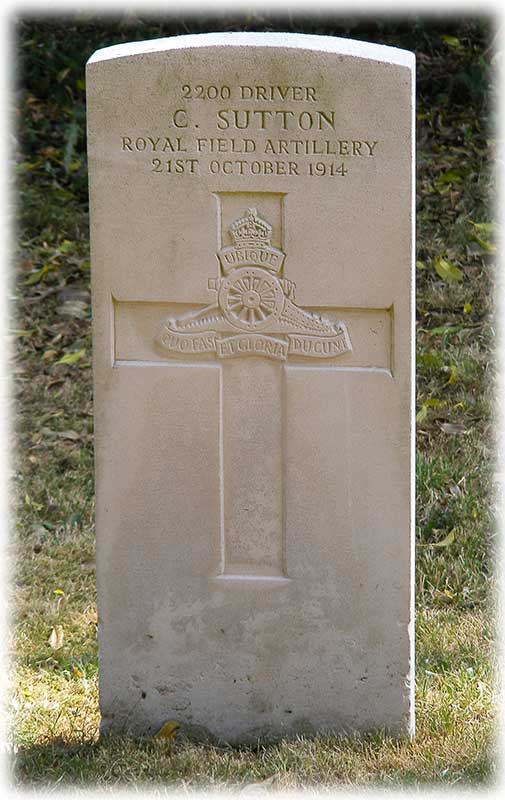 is
inscription reads: is
inscription reads:
2200 Driver
C Sutton
Royal Field Artillery
21st October 1914
The CWGC do not give his age or name his parents, but we think Charles
was born Malvern, the son of Edward and Emily Sutton of Lower Wyche. His
father Edward was a butcher.
Charles was a member of 2nd South Midlands (249) Brigade Royal Field
Artillery TA when he fell ill on the Isle of Wight and died in hospital.
We think he was aged only 17 years.
Charles was survived by his elder brothers Ernest James, who joined the
Army Service Corps, James Robert, a butcher like his father, and two
sisters.
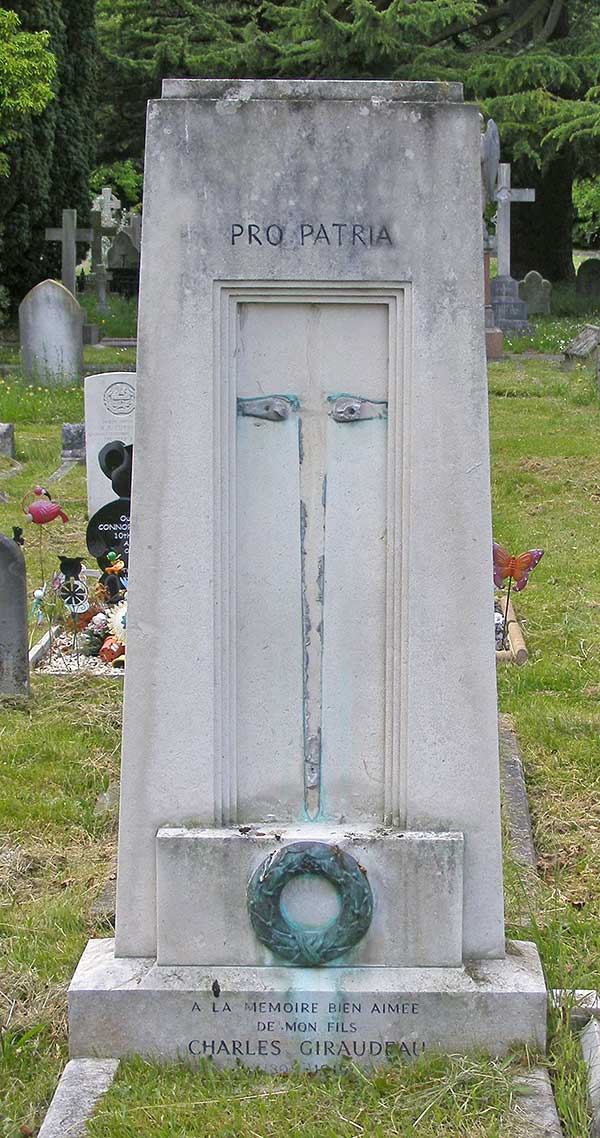
A tall monument containing the outline of a missing sword, above a laurel
wreath, marks the resting place of a young French soldier of the Great War.
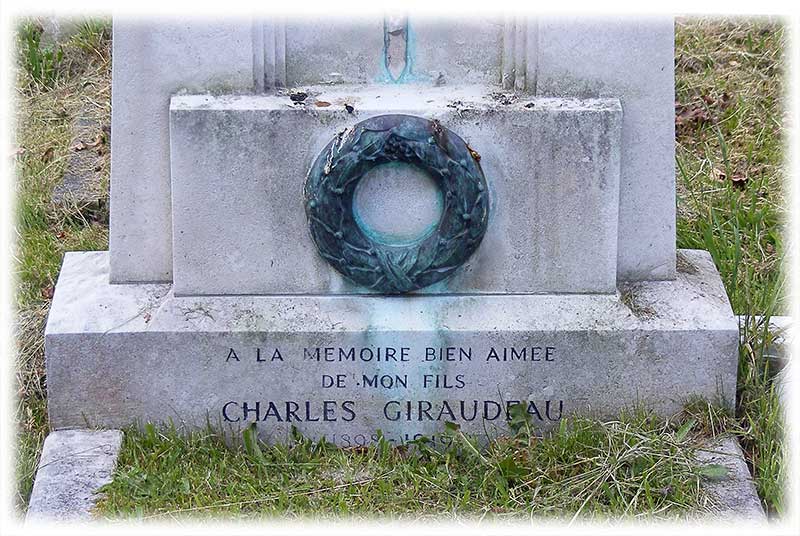
The touching inscription reads:
A la memoire bien aimee
De mon fils
Charles Giraudeau
1898 - 1919
Charles was born at Bernay in France on 21st December
1898 and he died at Malvern on 29th March 1919 aged 20 years.
He was a French soldier of the159th Regiment, Alpine Infantry, who had been evacuated to
Malvern for convalescence suffering from gas poisoning. He was probably
accommodated at a small Red Cross auxiliary hospital, subordinate to a
larger military hospital in Birmingham.
Malvern Urban District Council had made the old
Malvern Hospital, off Newtown Road, available to the Red Cross, and beds
were also made available at the then new Community hospital at Lansdowne
Crescent.
Rhydd Court, home of Sir Edmund Lechmere, and Brand Lodge, on Jubilee
Drive in Colwall, were also converted to convalescent hospitals (ref 4) as was
Ashfield in Malvern - this was probably the house named Ashfield in West
Malvern where Roget died, but could have been Ashfield House on the junction of Abbey Road and College Road.
Further beds were made available at houses in Cowleigh Road and Hornyold
Road.
Charles was the only son of Madame Giraudeau who was then
a member of staff at Clarendon School for Girls
in Cowleigh Road, North Malvern. His grave is not listed by the CWGC because
although France was an ally, only the casualties of Commonwealth soldiers
are recorded.
Charles obituary appeared in the Malvern Gazette on
Friday April 11th 1919. It reads:
Obituary
Charles Giraudeau
The funeral took place on Tuesday in the last week of
Charles Giraudeau, aged 20 years, a young French soldier who died on March
29th, from the effects of gas in the previous year.
He was the only son of Madame Giraudeau, who has for five
years been on the staff of Clarendon Girls' School, North Malvern.
The service was held at Holly Mount Church, and was
conducted by the Rev C F Perry, of the YMCA Birmingham. The coffin was borne
by six returned prisoners of war, and was covered with the French flag, on
which was placed a white satin cushion with the blue cap and decorations of
the deceased.
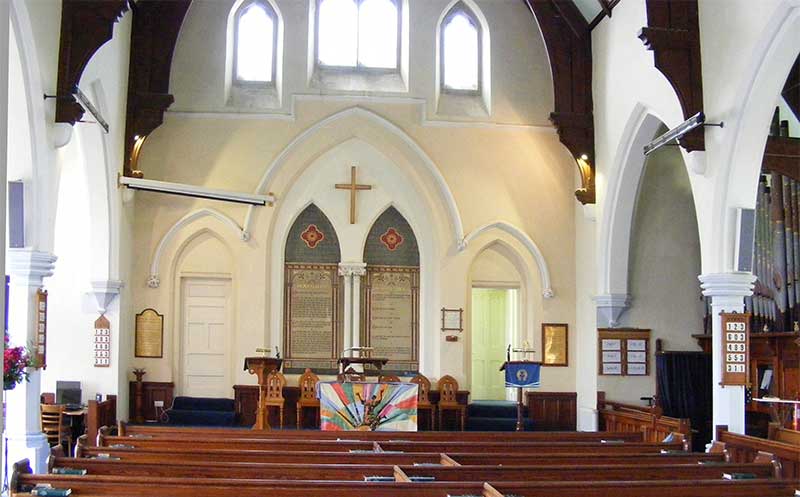
Holly Mount URC interior, 2016
There was a large attendance of friends. The hymns
were 'Jerusalem on high', and 'The saints of God', and the organist (Miss
Holland) played 'I waited for the Lord' (Mendlessohn), and other appropriate
music. The mourners were Madame Giraudeau (mother), Mademoiselle Giraudeau
(sister), the Misses Flint (of Clarendon), Mrs and Miss Pearson, Miss Muspratt, Miss
Calthrop, Mrs Inchley, Mr and Mrs Morris.
 The internment was in Malvern Cemetery. The grave was
lined with greenery, and after the committal sentences were said the 'Last
Post' was sounded. The internment was in Malvern Cemetery. The grave was
lined with greenery, and after the committal sentences were said the 'Last
Post' was sounded.
Wreaths were sent by Miss Barley; Miss Beeching;
Lieut Colonel Bowen KC, and Mrs Bowen in memory of a gallant French Soldier;
Miss Calthrop and Mrs Muspratt, to a soldier of France; a token of sincere
sympathy, from friends at Holly Mount Church; the staff of Clarendon;
Captain and Mrs Holden; Mrs Hulbert and family; Mademoiselle Julia; Mr and
Mrs Lloyd Jones; Mr and Mrs Morris and family; Miss Smith; Miss Williams.
Messrs Gwynn and Sons carried out the funeral
arrangements.
An Appreciation
A French friend writes of the deceased soldier as
follows:
Hard by the hills of Malvern, under the delicate branches
of a silver birch, lies a grave where the flowers have hardly faded. It is
that of a young hero of twenty, who tasted the joy of his country's victory,
and then gave his life as the result of his share in the gift. Of that
famous 159th Regiment of the Alpine Infantry which by its feats of arms won
the lanyard of the Cross-de-Guerre, Charles Giraudeau was surely the
youngest, and at the dawn on the 29th March he gently laid down his head to
rest, like a tired child in its mother's arms. They dressed him again in his
sky blue uniform, and laid on his coffin the flag of his country, and on a
cushion of whitest satin his blue cap and decorations. Six English soldiers
bore him to his grave. He lies in foreign soil, but in a country well
beloved, and his flag is with him yet, for the blue of hope, the white of
purity, and the red of faith, and the love of that country for which he
died, are still closely wrapped around him. At the end of the day – a quiet
evening under an austere English sky – all was over, and nothing was left to
us of what was once a soldier – rather famous, now renowned, the faithful
servant of his daily duty. Nothing is left to those who are, and those who
shall be, save the sacred memory, and the great example, of the boy of 20,
who has joined the glorious company of those who for freedom's sake laid
down their lives for France.
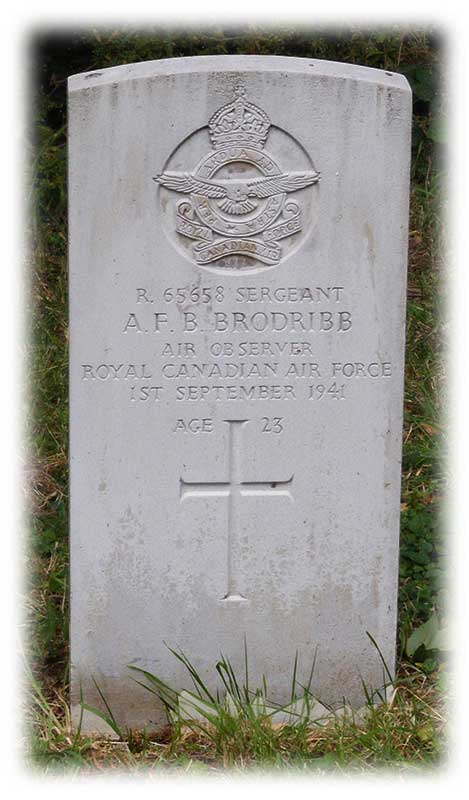 On
the south western boundary of the cemetery are two Second World War graves. On
the south western boundary of the cemetery are two Second World War graves.
One is inscribed:
R 65658 Sergeant
A F B Brodribb
Air Observer
Royal Canadian Air Force
1st September 1941
Age 23
He was the son of Francis Bower Brodribb, a civil
engineer, born London, who had emigrated to Ontario, Canada with his wife
Nellie Gwendolyn Morgan Brodribb.
AFB Brodribb attached to 99 Squadron Bomber Command at
RAF Waterbeach in Cambridgshire was killed when his
Vickers Wellington bomber crashed in a field in Suffolk after being
attacked by a
Junkers
88 night-fighter as it came in to land.
We wondered why a Canadian who crashed in Suffolk should
be buried in Great Malvern cemetery, and the answer proved to be quite
simple. His mother Nellie Gwendolyn Morgan had been born 1st August 1893 at
St Winefrides in Wilton Road, Great Malvern, and perhaps it was his uncle Tom
Higgins Cook Morgan or aunt Ruth Winefride Morgan who arranged his burial in
Malvern, yards from the old family home.
Anthony was survived by his brothers Peter and Richard Bower
Brodribb.
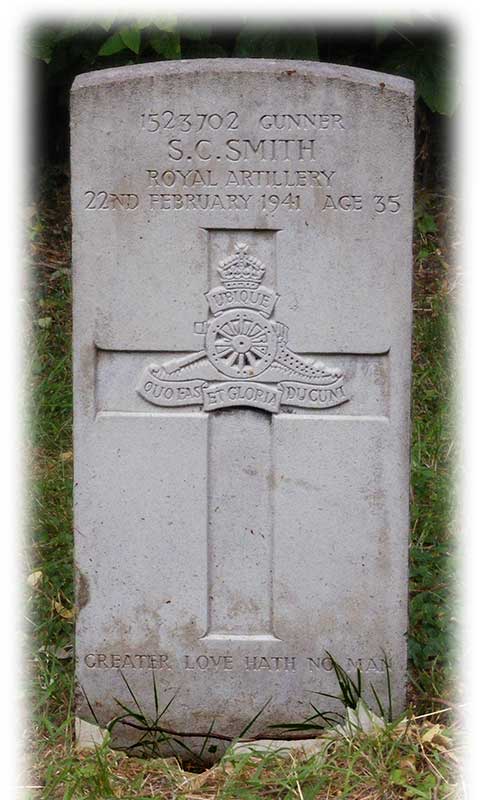 The
inscription reads: The
inscription reads:
153072 Gunner
S C Smith
Royal Artillery
22nd February 1941
Aged 35
Greater love hath no man
Sidney was a member of 149 Battery, 27th Light Anti Aircraft Regiment.
We have not been able to find out anything about 149 Battery but wonder
if the unit was then equipped with light machine guns to protect English
airfields.
Sidney, born Malvern in 1905, was the son of Albert Smith and Harriett
Stone of north Malvern. The 1911 census recorded Albert as an upholsterer
of 6 Labernum Terrace, Newtown, Malvern.
Sidney was survived by his elder brothers Albert William, Christopher
Ernest and Joseph Harold Smith, who lived to a good age. Joseph died at
Woodside, Guarlford in 1960.
Not far away, there are two memorials to the MacDonald family.
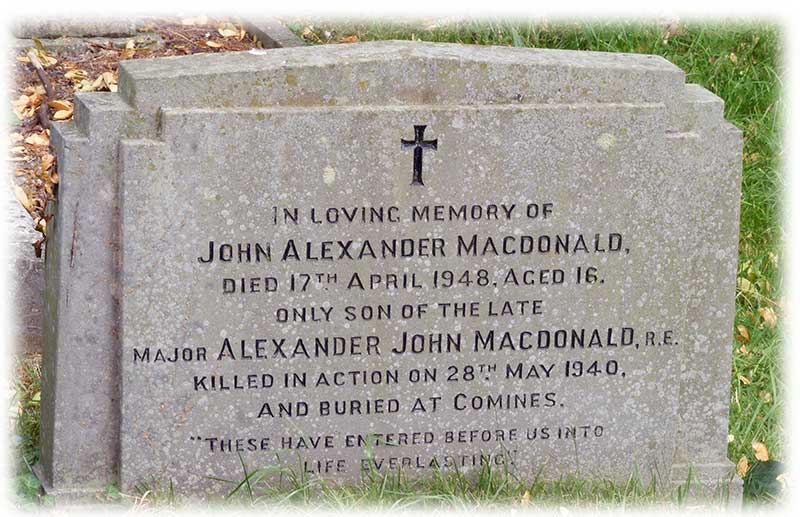 The
first inscription reads: The
first inscription reads:
In loving memory of
John Alexander MacDonald
Died 17th April 1948, aged 16
only son of the late
Major Alexander John MacDonald, RE
Killed in action on 28th May 1940
and buried at Comines
'These have entered before us into everlasting life'
Major, 894, Alexander John MacDonald, 59 Field Company,
Royal Engineers, was probably killed in
Belgium during the withdrawal of the British
Army to Dunkirk. He was aged 39 years and mentioned in despatches.
Alexander was the son of Colonel Frederick Weston Peile
MacDonald (1863 - 1955), formerly of the Indian Army, and of Edith Inez
Macdonald (nee Powlett). Alexander married Stella Constance Christian Stuart
in 1929 and in addition to their son John they had a daughter Jean Constance
Lucy MacDonald born 1929.
Stella was a descendant of Sir David Pollock who was
appointed Chief Justice of Bombay in 1846 and knighted in the same year.
Stella's memorial is a tablet laid in the grass.
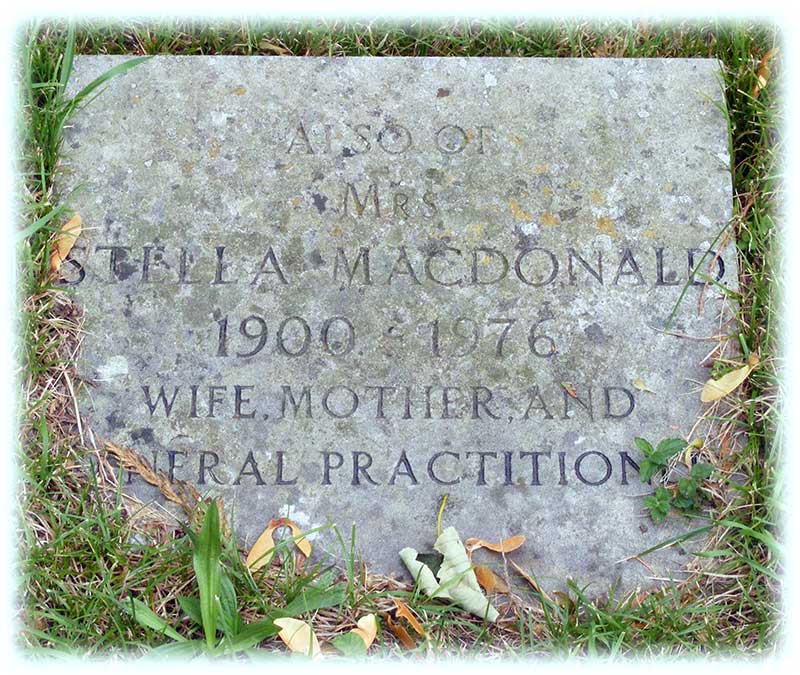 The
inscription reads: The
inscription reads:
Also of Mrs
Stella MacDonald
1900 - 1976
Wife, mother, and
General Practioner
We don't know the McDonalds' connection with Malvern but
surmise Alexander's parents retired to Great Malvern and lived at 'Howards' in
Avenue Road where his mother was living at the time of her death.
In 1957 Stella, with many others, was admitted to the
Order of the Hospital of St John of Jerusalem.
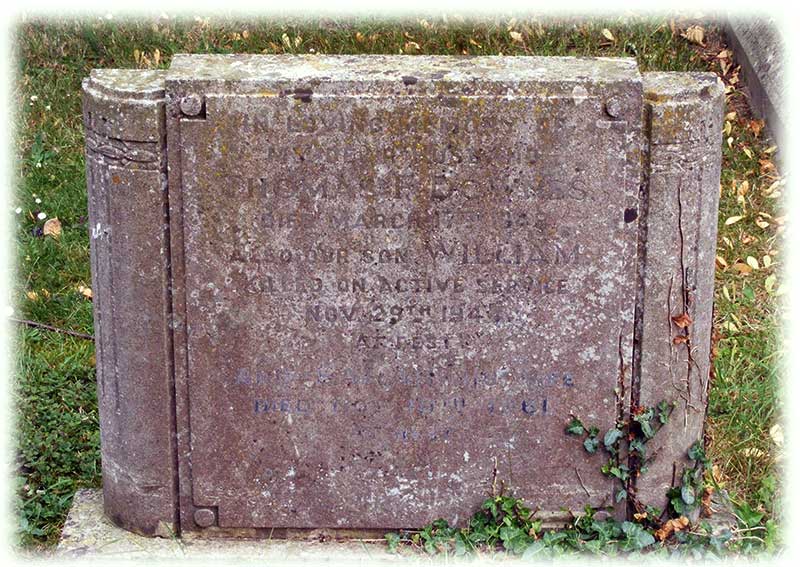 Not
far away is a memorial to Thomas Frederick Downes (1885-1948), his wife
Sarah (1884-1961) and their son William. Not
far away is a memorial to Thomas Frederick Downes (1885-1948), his wife
Sarah (1884-1961) and their son William.
The inscription is worn away at the base but appears to
read:
In loving memory of my dear husband
Thomas F Downes
Died March 17th 1948
Also our son William
Killed on active service
Died November 29th 1944
At rest
Faintly below is written:
Also Sarah wife of above
Died Nov 19th 1961
At rest
Thomas Frederick Downes married Sarah Batkin in 1907. In
the 1911 census he is recorded as a publican and monger of Birmingham. They
had two sons Thomas Frederick born 1908 and William Henry born 1913. At the
time of his death Thomas was living at Lansdowne Close, on the north side of the
cemetery.
At the outbreak of war in 1939, William married Esther Algava
Seaborne and they lived at 101, Pickersleigh Road, Malvern.
The CWGC database records:
William Henry Downes, known as Bill
Gunner 1085753
88 Field Regiment Royal Artillery
Died 29th November 1944, aged 31 years
Commemorated
Kachanaburi War Cemetery, Thailand
The inscription at the bottom of his memorial at
Kachanaburi reads:
To the memory of Bill, my beloved husband
God's greatest gift. Remembrance
During the Second world War, 88 (2nd West Lancashire) Field Regiment fought in France
and Belgium in 1939-40 before being posted to Malaya in 1941. They fought in
the
defence of Malaya against Japanese forces throughout 1941.
Read more
They then withdrew and went on to see action in
Singapore, where they were captured by the Japanese.
Sadly, William was just one of thousands of Allied POWs and
others, who were treated very harshly by the Japanese, and died, far from
home, building the
Burma
Railway.
The Commonwealth War Graves Commission records other
burials which are listed below; the CWGC also recorded that:
Great Malvern cemetery originally belonged to the Malvern
and Guarlford Joint Burials Committee. It was begun in 1861 and now covers
more than 14 acres. A handwritten amendment records that from 1/4/1954 it came under Malvern UDC.
The cemetery is now managed by Malvern Town Council.
Died of pneumonia at Winchester on 25 October 1918 aged 25 years.
He was a Captain, Hants Bty, Royal Garrison Artillery, and had been
stationed at
Horse
Sand Fort off Portsmouth.
Alan was the son of glass merchant Arthur Thomas
Bate (born Malvern Wells,1858-1941) and Alice Florine Maude Barker.
His mother Alice was the daughter of banker Christopher
Dove Barker and Alice Gray Elmslie (1835-1918) who lived at a large mansion
known as Radnor House in
College Road, Great Malvern. The house is now one of the boarding houses of
Malvern College public school.
Alan had married Frances Eva King in 1916; he was
survived by his brother Leonard Robert Arthur Bate and a sister.
A photo of his memorial in Great Malvern cemetery can be found on the Find a
Grave website
Thomas Bowley, born at Malvern in 1868, and died of
sickness in England on 27th December 1916 was a Driver,
service number '71800' based at the Royal Engineers' Wireless Training Centre at
Worcester.
A veterans' website quotes:
We trained at Worcester and Morton on British field
sets with a cat’s whisker receiver; there were no amplifiers in those days.
Little is said about 'Wireless' in WWI but it appears it
did have a role to play; for example
see this blog about sigint.
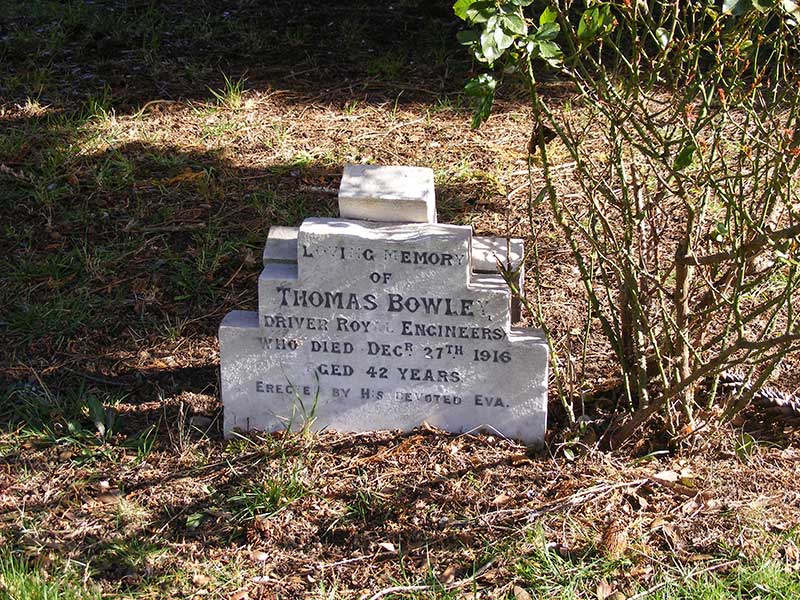
Strangely, Thomas does not have a CWGC headstone, but a
civilian monument topped by a cross which has become detached and now lies
behind the inscribed base. The inscription reads:
Loving Memory of Thomas Bowley,
Driver Royal Engineers
who died December 27th 1916
aged 42 years
Erected by his devoted Eva
Thomas is thought to have been a Malvern man, the son of farm labourer William and
Sarah Bowley. In 1891 he married Mary Ann Edgington. The 1911 census
records that Thomas had been a jobbing gardener of 2 St Mary, Woodshears
Road, Malvern, married 20 years with one daughter. Sadly his wife had died in 1912.
There are two mysteries about the inscription. Thomas was
born in 1868, so in 1916 would have been 48; did he lie about his age in
order to get into the army? Secondly, who was Eva who commissioned the
headstone. Was she his fiancee and prospective second wife or was this the
nickname of his only daughter, Frances Marion Elizabeth born 1894 who died
at Worcester in 1980?
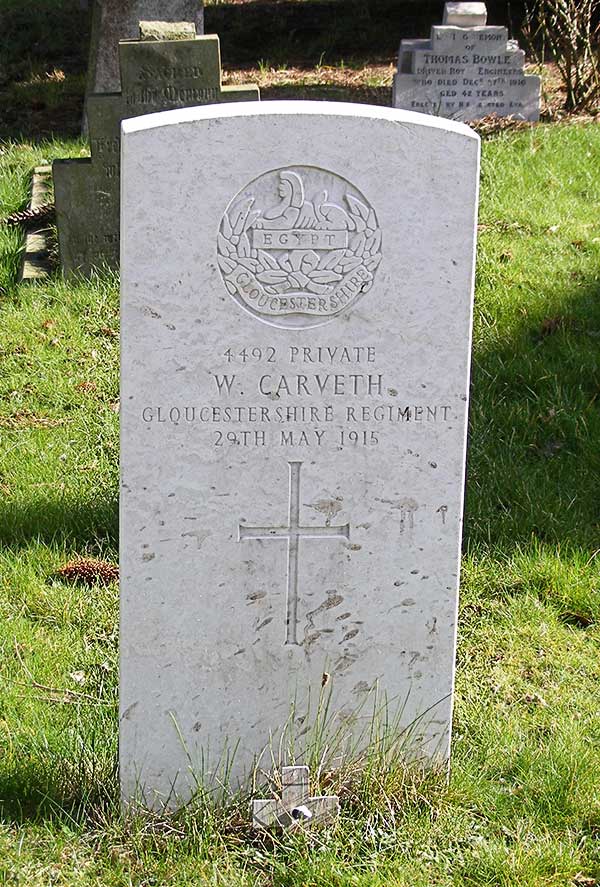
The grave of William Carveth lies next to that of
Kenneth
Williams a few yards north east of the chapel and mortuary. The inscription on his headstone reads:
4492 Private
W. Carveth
Gloucestershire Regiment
29th May 1915
Possibly aged 21, he was killed in an accident on the railway at Malvern
Wells where the Gloucestershires were attending a training camp at Peachfield Common.
His mother was Mrs John Carveth of Ontario, Canada.
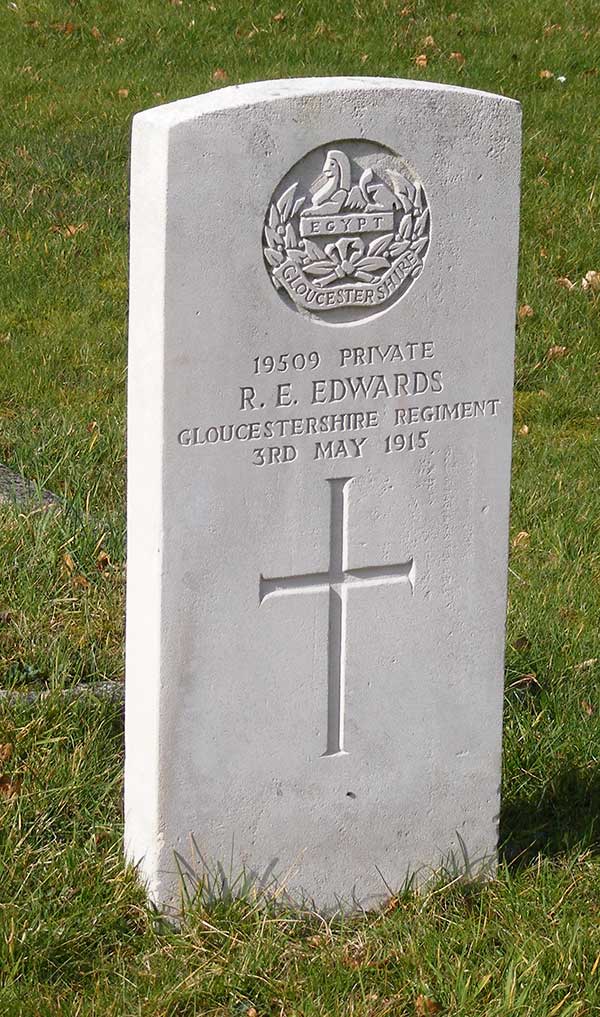 His
headstone reads: His
headstone reads:
19509 Private
R E Edwards
Gloucestershire Regiment
3rd May 1915
Died at Malvern aged 35 years. 13th Battalion,
Gloucestershire Regiment (Forest of Dean Pioneers).
We know little about him
except that he was born at Llandudno, enlisted at West Hartlepool and his wife
may have lived at 3 Provence Road, Bootle, Lancashire. He is
listed on the
Llandudno
War Memorial.
Like William Carveth he may also have died from sickness
or injury at the training camp on Peachfield
Common.
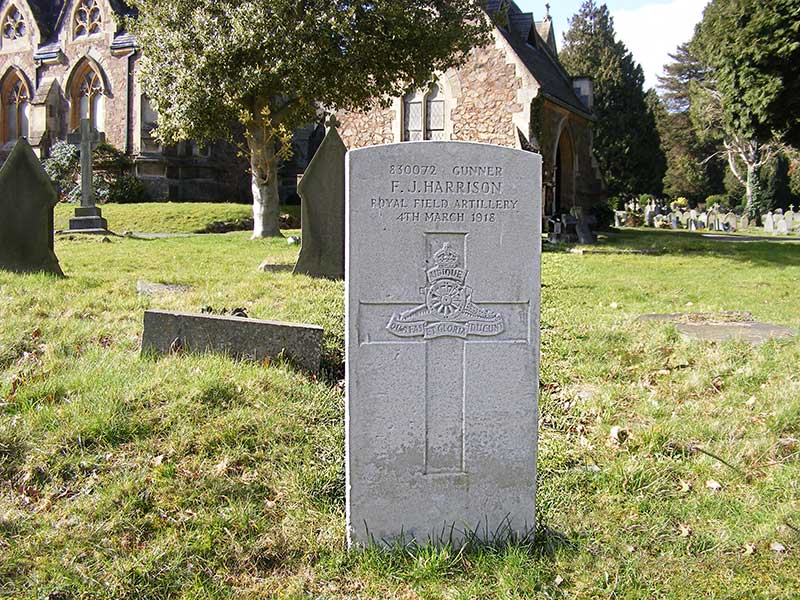
His headstone reads:
830072 Gunner
F J Harrison
Royal Field Artillery
4th March 1916
It seems Francis was wounded on active service on several
occasions and sadly took his own life on the railway at High Wycombe aged only
27 years.
He was a member of 4th Reserve Brigade,
Royal Field Artillery.
Born 1890 and one of a large family, the 1911 census
records that he was the son of bank clerk Richard Henry and Sarah Harrison
then of Langham Villa, Barnards Green, Malvern, where new shops now stand
recently
occupied by Jane's Flower Box, and the Toy Corner.
After his father died in 1912, his mother Sarah moved to
Barber's Hill now known as Wedderburn Road, off Pound Bank.
Aged 20, Francis had been an assistant attendant at Malvern
College Gymnasium.
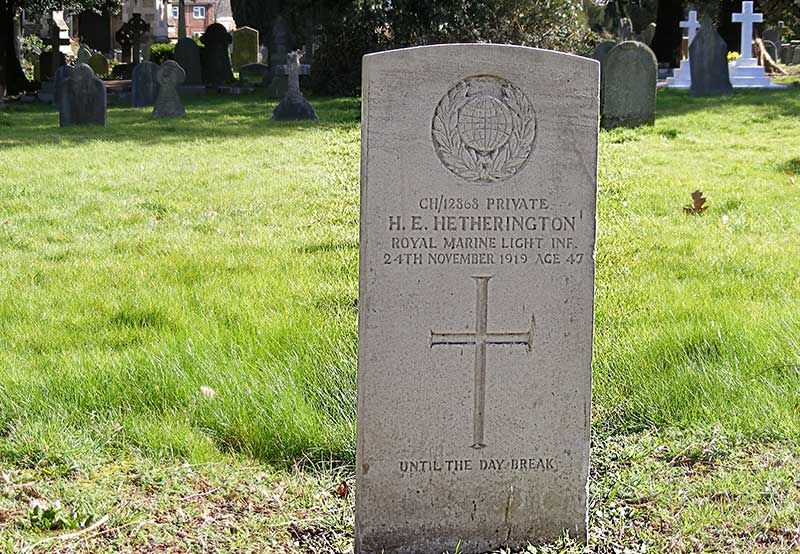
The inscription on his headstone in the south west quadrant of the
churchyard reads:
CH/12868 Private
H E Hetherington
Royal Marine Light Infantry
24th November 1919 age 47
Until the day break
Henry was the son of musician Henry Ralph and Frances
Hetherington, of Pimlico, London born on 8th Sep 1872.
He enlisted with the RMLI, Chatham Division on 8th
October 1890.
The 1911 census records him on board
HMS Vanguard, First Class Battleship, Portland Harbour, commanded by
Captain John Bridges Eustace.
In 1901 at Alverstoke he married Lily Sabina Williams
(1871 - 1937) and they had three daughters. Lily is later recorded at 14
Upper Chase Road, Great Malvern.
Died on 27th May 1917 aged 45 years. Private 33239, 10th Bn Welsh Regiment.
Edward Evan Llewellyn was born 1872, St Athan,
Glamorganshire, Wales, the son of agricultural labourer Thomas and Mary
Jenkins Llewellyn. He was one of a large family and in 1901 he was a coal
miner.
We assume, he was injured and brought to Malvern to convalesce, where
he died.
He was survived by his youngest brother Arthur William
Llewellyn and other siblings. As his parents had died, his next of kin was
recorded as his brother J Llewellyn of 61 Salisbury Rd, Barry, Glamorgan.
A photo of his memorial can be found on the Find a Grave website
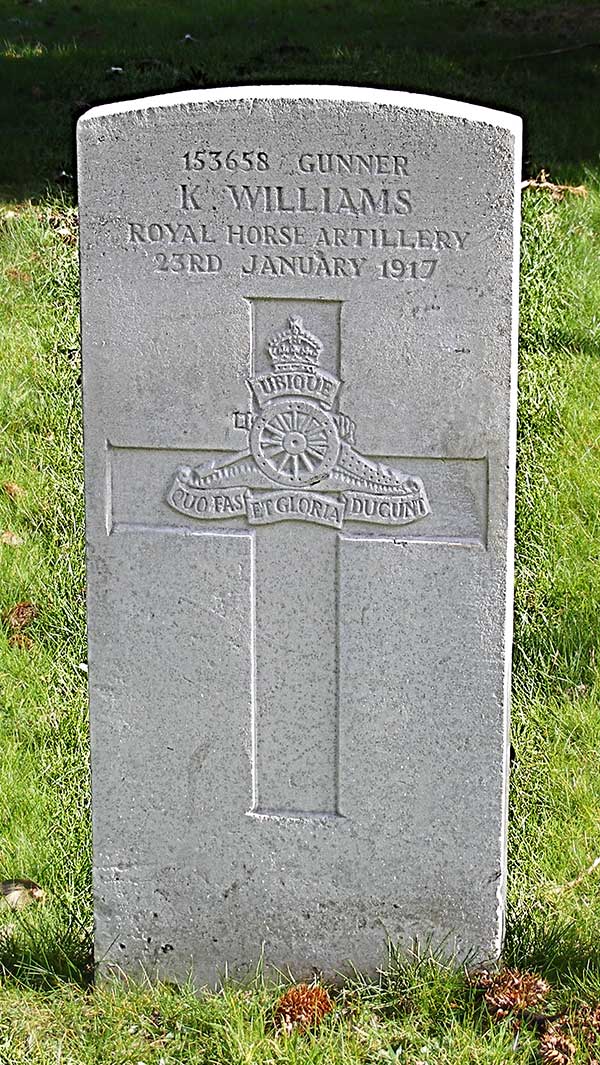 The
inscription on his headstone reads: The
inscription on his headstone reads:
153658 Gunner
K Williams
Royal Horse Artillery
23rd January 1917
He was attached to 'P' Battery, Royal Horse Artillery which may have been a home based training unit at Larkhill.
We have not been able to identify him in the census, but
possibly this was Kenneth C Williams listed on the roll of the fallen in
Christ Church, Avenue Road.
A manuscript CWGC document records that he was the son of
Mrs E Williams of Hawthorn Lodge, Lower Wilton Road, Malvern.
Died on 16th April 1941 at Brentford, Middlesex aged 25 years. Private 7634996, Royal Army Ordnance Corps.
We think he was the son of butler Edwin and Alice Jane
Sparks nee Dew, born Aldbourne, Wiltshire 1906.
Possibly his parents had moved to work in Great Malvern,
as his mother died at Malvern in 1974.
He does not have a CWGC headstone and his grave is marked
by kerbing overgrown by grass.
A photo can be found on the Find a Grave website
Died at Malvern on 31st May 1942 aged 37 years. Corporal Home Guard 7th Worcestershire
(Malvern) Bn. Son of
bank accountant Frederic Whitfield and Mary Evans of the Gower,
Glamorganshire.
He married Hilda Alexandra Ponder in 1937 and they lived
at 4 Bello
Squardo Mansions, Foley Terrace, St Ann's Road, Malvern, a Victorian
Villa built on the site of an old chapel circa 1825. They had a two year old
son.
Mick Wilks relates in his excellent book 'Chronicles of the Home Guard'
(ref 7)
that:
Corporal Evans collapsed while on Home-Guard manouvres at
Blackmore Park. He was given first aid and taken home by car where he died
soon afterwards; he had been employed as an accountant at the Midland Bank,
Malvern and was a keen golfer.
He does not have a Commonwealth War Grave Commission
headstone.
His elder brother Whitfeld David Evans died, not long
after, at Derby in 1945, aged 44 years. In 1916 he had joined the London and
North Western Railway aged 16 years. The London Gazette listed that he was a
Flight Cadet made 2nd Lt Air Observer in 1918 and in 1928 he was made a Lt
in the Royal Engineers Transport reserve. Passenger lists record him as an
Engineer travelling to and from from Argentina in the 1930s.
A photo of his headstone can be found on Find a Grave
References.
- The Times
- Great Malvern Victorian Cemetery, printed by Aspect Design 2013 (a
booklet published by Malvern Civic Society).
- Oxford Dictionary of National Biography.
- Malvern in the Great War 1914, published 2014 by Malvern Museum,
ISBN978-0-954-1520-6-2
- National Probate Calendar
- Commonwealth War Graves Commission website
- Wilks, Mick, Chronicles of the Worcester Home Guard, Logaston Press
2014, ISBN 978 1 906663 87 2
- Communication from Giles Smith, May 2016
- RAF Museum story vault archive, casualty card.
-
Amersham Remembers, the men who gave their lives in the Great War
 Continue
to tour 3 Continue
to tour 3
Go to Menu of tours
Back to top
If you are able to correct or add to the stories on this
page please get in touch by contacting the webmaster
|